
Which Gyroball Should You Buy in 2026? An Expert’s Buying Guide

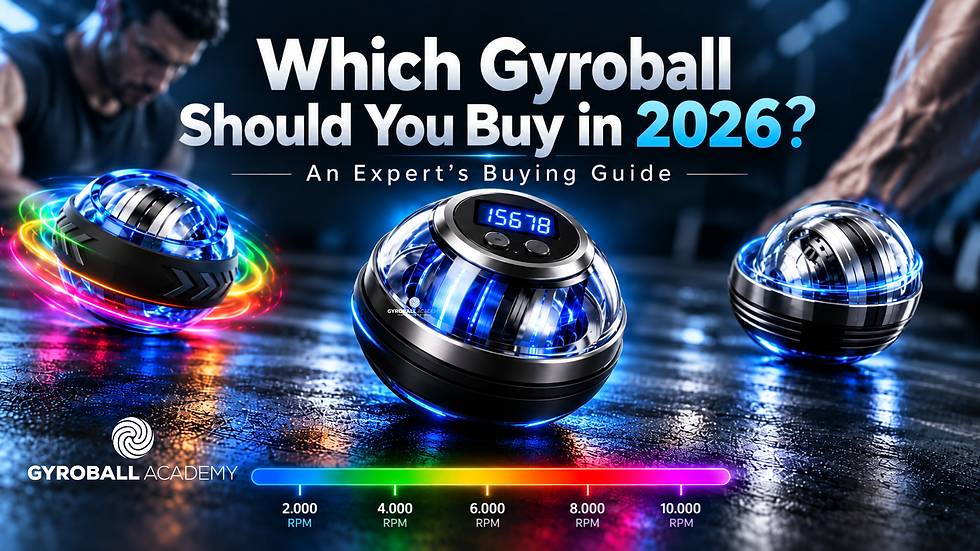
If you want the short answer: for most first-time buyers, I would start with a self-starting gyroball. It removes the friction of learning a string start and lets you focus on what matters: controlling the rotor, building coordination, and learning how your hand and forearm respond to changing resistance.
My current value pick is the Recommended Auto-Start Gyroball. If you want measurable performance rather than just an easy entry point, I would move up to an NSD model with a built-in digital counter.
My Picks in 2026
Best for Most People: Recommended Auto-Start Gyroball
This is the option I would point most beginners to first. It is self-starting, inexpensive, and simple enough that you can begin practicing without turning the start-up process into the workout. You do not need advanced electronics to learn the basic skill of keeping a gyroball stable, accelerating it, and controlling the eccentric braking forces it creates.
Best for Performance Tracking: NSD with Digital Counter
If you already know you will use a gyroball consistently and want objective feedback, a built-in digital counter is more useful than decorative lighting. It gives you a way to compare sessions, monitor speed and rotations, and turn practice into measurable training. The NSD model I am linking here uses an onboard display; it is not the Bluetooth version.
What I Would Not Prioritize
I would not choose a gyroball simply because it is the cheapest one available. A very low price can make sense if you only want to experiment, but a few extra dollars can buy a self-start mechanism, better usability, or a counter that gives you meaningful feedback. I also would not pay more only for LEDs. Lights can be fun, but they are less useful than a reliable start system or a real performance display.
Self-Start vs. String Start
For a first gyroball, self-start wins on convenience. A string-start model can still work perfectly well, and experienced users may not care, but beginners often waste time learning the launch instead of learning rotor control. A self-starting mechanism lowers that barrier.
Lights, Counter, or Bluetooth?
Speed-reactive lights can give rough visual feedback, but they are not precise training data. A digital counter is the more useful upgrade if you want to measure improvement. Bluetooth adds another layer of information and app-based feedback, but I would only pay for it if you actually want to train with an app. Otherwise, the onboard counter is simpler.
How I Judge a Gyroball as a Trainer
I do not judge a gyroball by maximum RPM alone. What matters more is whether the device lets you build controlled acceleration, deceleration, grip adaptation, and proprioceptive response. The resistance is created by the spinning rotor, and much of the training value comes from controlling that resistance rather than simply chasing speed.
That is also why I prefer a device you will actually use. A theoretically superior gyroball that is awkward to start or too complicated to track may be less useful than a simpler model you train with consistently.
Which One Should You Buy?
Choose the Recommended Auto-Start Gyroball if you are new to gyroball training, want the easiest entry point, or care most about value. Choose the NSD with Digital Counter if you want to track performance and expect to use the gyroball as a regular training tool.
If you already own a basic gyroball, you do not necessarily need to replace it. Technique and consistent training matter more than adding features. Upgrade when the new feature solves a real limitation for you, such as difficult starting or lack of measurable feedback.
Before You Train
A gyroball can generate substantial resistance as speed rises. Do not confuse maximum speed with good technique. Learn to control the movement, keep the wrist comfortable, and progress gradually.
For a deeper explanation of how the device works, read What a Gyroball Actually Does.
If you are concerned about technique and injury risk, read Can a Gyroball Damage Your Arm?.
And if you are still deciding whether this kind of training is worth doing, see Do Gyroballs Really Work?.
Disclosure: Some links on this page are affiliate links. If you buy through them, GyroBull may earn a commission at no additional cost to you.


Comments